
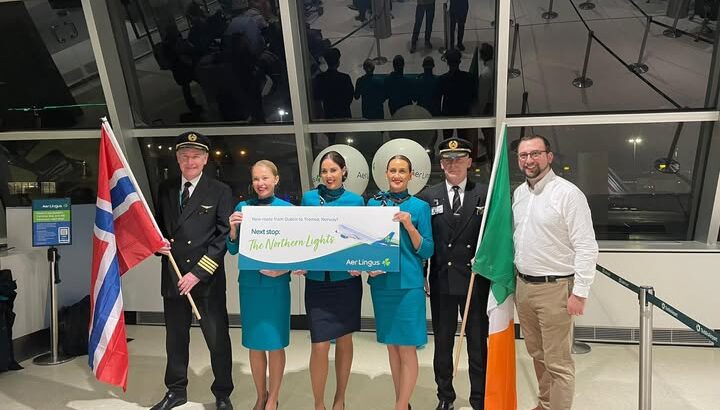
Aer Lingus has strengthened its Nordic Presence with Norwegian Expansion launching a new route from Dublin to Tromsø (TOS) during the winter season, from 3 December 2025, to 25 March 2026, operating twice weekly on Wednesdays and Sundays using 174 seat Airbus A320-200 aircraft. The inaugural flight was operated by A320 EI-DES msn 2635.
Aer Lings announced an new Summer route between Dublin and Oslo Gardermoen (OSL) from 1 May to 26 October, 2026, operating four times weekly on Monday, Tuesday, Thursday and Sunday, using 174 seat Airbus A320-200 aircraft.
Aer Lingus Chief Customer Officer Susanne Carberry, said “Today marks a milestone for Aer Lingus as our inaugural direct service from Dublin to Tromsø takes flight, introducing Norway to our network for the very first time. This exciting new route gives customers in Ireland the opportunity to experience the natural beauty and unique adventures of Northern Norway this winter. It also enhances the region’s connectivity to the US, making the area easily accessible via Aer Lingus’ Dublin Hub.”
Ulv Elbirk, Director Route Development, Asia & Americas at Avinor said “Aer Lingus has not flown to Scandinavia since March 2016 and has never operated to or from Norway before. The airline launched its Tromsø service on December 3, and will begin operating to Oslo on May 1 next year. We see this as a great addition to the route offerings in both Tromsø and Oslo, and we look forward to welcoming Aer Lingus.”
The new routes to Oslo Gardermoen (Summer) and Tromsø (Winter) are expected to increase inbound Irish tourism to Northern Norway and strengthen Aer Lingus Dublin hub-and-spoke strategy, enabling passengers to clear U.S. Preclearance in Dublin and connect seamlessly up to and from 16 North American cities.
Image Credit: Dublin Airport
Irish Aviation Research Institute © 1 January 2026 All Rights Reserved